Learn the 10 key safety and quality risks in children's clothing
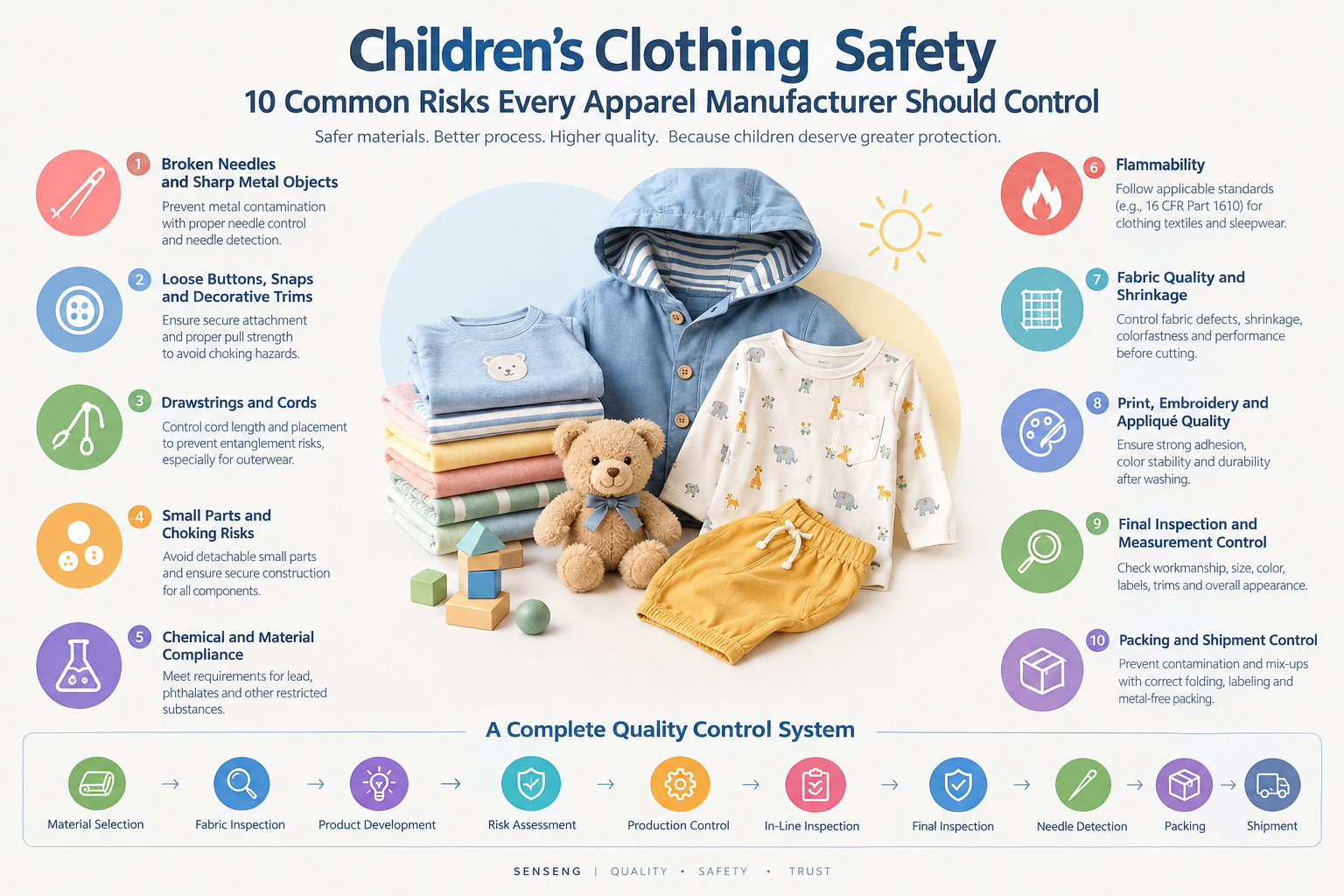 Children’s Clothing Safety: 10 Common Risks Every Apparel Manufacturer Should Control
 Children’s Clothing Safety: 10 Common Risks Every Apparel Manufacturer Should Control
Children’s clothing requires more than good design and attractive workmanship. It requires a carefully controlled approach to product safety.
For apparel brands, retailers, and importers, choosing the right children's clothing manufacturer is an important part of managing product risk. A garment may look perfect during a final visual inspection while still having potential safety issues related to needles, buttons, trims, cords, chemicals, flammability, or other components.
A reliable children's apparel factory should therefore have a systematic quality-control process that begins with material selection and continues through production, inspection, testing, and final packing.
In this article, we look at 10 common safety and quality risks in children's clothing and how professional apparel manufacturers can control them.
1. Broken Needles and Sharp Metal Objects
One of the most basic but important risks in garment manufacturing is broken sewing needles.
Sewing machines operate at high speed, and needles can break during production because of machine conditions, fabric thickness, improper needle selection, or other factors.
A broken needle may leave a small metal fragment inside a garment or on the production floor.
For children's apparel, visual inspection alone may not be sufficient to identify every small metal fragment.
A professional factory should therefore have a broken-needle control procedure covering:
-
Needle issue and replacement
-
Broken needle reporting
-
Recovery and accounting of broken pieces
-
Operator responsibilities
-
Quality-control verification
-
Needle detection of finished garments
-
Records and corrective actions
Needle detection should be treated as part of a broader safety-control system rather than simply a final machine inspection.
2. Loose Buttons, Snaps and Decorative Trims
Buttons, snaps, bows, badges, appliqués, sequins, and other decorative components can create safety concerns if they become detached from a garment.
For children's products, components must be securely attached and appropriate for the intended age group.
A factory should consider:
-
Button and snap attachment
-
Pull strength
-
Stitching quality
-
Attachment construction
-
Decorative trim security
-
Potential sharp edges or points
-
Durability after washing and normal use
CPSC guidance specifically identifies buttons, snaps, and decorations that can easily detach as potential choking concerns for children's clothing.
This is why trim inspection and pull testing should be incorporated into children's apparel quality control, rather than relying only on visual appearance.
3. Drawstrings and Cords
Drawstrings are another important safety consideration, particularly for children's outerwear.
The U.S. Consumer Product Safety Commission has identified certain drawstrings on children's upper outerwear as a substantial product hazard because they can become caught on playground equipment, vehicle doors, and other objects.
For example, hood and neck drawstrings are prohibited under the applicable requirements for children's upper outerwear in sizes 2T through 12, while specific requirements also apply to waist and bottom drawstrings in sizes 2T through 16.
Therefore, when developing children's garments, manufacturers should review:
-
Hood and neck cords
-
Waist drawstrings
-
Cord length
-
Toggles and knots
-
Cord attachment
-
Bar-tacking where applicable
-
Garment size and intended age group
Safety should be considered during design development, not after bulk production begins.
4. Small Parts and Choking Risks
Young children naturally pull, chew, and explore objects with their hands and mouths.
This means that small garment components deserve particular attention.
Potentially detachable components may include:
-
Buttons
-
Decorative pieces
-
Badges
-
Certain plastic components
-
Fasteners
-
Small accessories
The U.S. CPSC has specific requirements concerning small parts and choking hazards for children's products, and the applicable requirements depend on the product and age group.
For apparel manufacturers, the practical lesson is clear:
A component should not be evaluated only by how it looks when the garment leaves the factory. Its attachment and durability also need to be considered.
5. Chemical and Material Compliance
Children's clothing can contain many different materials and components:
-
Main fabrics
-
Dyes and finishes
-
Prints
-
Coatings
-
Buttons
-
Zippers
-
Snaps
-
Labels
-
Plastic components
-
Metallic components
Depending on the destination market and product, different chemical and material requirements may apply.
For the U.S. market, children's products are subject to applicable requirements concerning substances such as lead, while certain phthalate restrictions apply to children's toys and child care articles. CPSC guidance also explains requirements for applicable third-party testing and certification.
A responsible manufacturer should therefore understand the customer's target market and product requirements before production begins.
This is one reason material sourcing and compliance should be connected, rather than treated as separate processes.
6. Flammability
Flammability is another important consideration for apparel sold in the United States.
CPSC identifies flammability requirements under 16 CFR Part 1610 for clothing textiles, with additional requirements applying to certain children's sleepwear under 16 CFR Parts 1615 and 1616.
The applicable requirement depends on the garment type, fabric, construction, and intended use.
A manufacturer should therefore evaluate the fabric and garment construction during product development rather than waiting until the finished goods are ready to ship.
7. Fabric Quality and Shrinkage
Not every children's clothing problem is an obvious safety hazard.
Fabric quality can also affect garment performance, appearance, sizing, and customer satisfaction.
For example, uncontrolled shrinkage can result in:
-
Incorrect garment measurements
-
Poor fit after washing
-
Twisting or distortion
-
Uneven appearance
-
Increased customer complaints
Professional apparel production should include appropriate fabric inspection and testing before bulk cutting.
Depending on the product, manufacturers may need to evaluate:
-
Fabric weight
-
Width
-
Color
-
Shrinkage
-
Colorfastness
-
Fabric defects
-
Hand feel
-
Construction
-
Performance after washing
Good garment quality starts before the fabric reaches the cutting table.
8. Print, Embroidery and Appliqué Quality
Children's apparel frequently uses graphics, embroidery, appliqués, patches, heat transfers, and other decorative techniques.
These details are important to the overall appearance of the garment, but they also need to withstand normal use and washing.
Quality control should consider:
-
Print adhesion
-
Embroidery security
-
Appliqué attachment
-
Edge quality
-
Surface defects
-
Color migration
-
Washing durability
-
Placement accuracy
A design that looks excellent on a pre-production sample is not necessarily a successful bulk-production result.
The factory needs to make sure that the approved construction can be reproduced consistently across the entire production run.
9. Final Inspection and Measurement Control
Even when materials and production processes are controlled, finished garments still need a systematic final inspection.
A proper final inspection may include:
-
Measurements
-
Sewing workmanship
-
Fabric defects
-
Color consistency
-
Stains and contamination
-
Trim attachment
-
Print and embroidery
-
Labels
-
Packaging
-
Needle detection
-
Overall appearance
The purpose is not simply to find defective garments.
A good inspection system should also provide information that can be used to identify recurring production problems and prevent them from happening again.
This is particularly important for brands working with multiple styles and seasonal collections.
10. Packing and Shipment Control
Quality control does not necessarily end when a garment passes final inspection.
The packing process can also introduce problems if it is not properly controlled.
For children's apparel, factories should consider:
-
Correct folding
-
Correct labels and packaging
-
Metal contamination control
-
Packaging specifications
-
Carton quantity
-
Size assortment
-
Final shipment inspection
-
Traceability
After a garment passes a safety inspection, it should be protected from unnecessary contamination or mix-ups before shipment.
The final goal is not simply to manufacture a good garment. It is to deliver the correct garment safely and consistently to the customer.
A Good Children's Apparel Factory Needs a System, Not Just an Inspection
One of the biggest misconceptions in apparel manufacturing is that quality control means inspecting finished garments.
In reality, quality should be controlled throughout the entire production process.
A strong children's apparel quality system can be viewed as:
Material Selection → Fabric Inspection → Product Development → Risk Assessment → Production Control → In-Line Inspection → Final Inspection → Needle Detection → Packing → Shipment
Each stage provides another opportunity to identify and control risk.
If a problem is discovered only during final inspection, the factory may already have wasted fabric, labor, production capacity, and shipping time.
The earlier a potential problem is identified, the easier and less expensive it is to correct.
What Should Brands Ask a Children's Clothing Manufacturer?
Before choosing a supplier, buyers should ask more than just:
"What is your MOQ?"
A better supplier evaluation should also include questions such as:
1. How do you control broken needles?
2. Do finished garments pass through a needle detector?
3. How do you test buttons, snaps, and other trims?
4. How do you control children's clothing safety risks?
5. How do you inspect fabric before bulk production?
6. How do you control shrinkage and colorfastness?
7. How do you manage print, embroidery, and appliqué quality?
8. How do you handle failed inspections?
9. Can you support the testing requirements for our target market?
10. Do you have documented quality-control procedures?
These questions can reveal much more about a factory's capabilities than simply looking at a showroom or product catalog.
Why Quality Control Matters to Children's Apparel Brands
For a children's apparel brand, a manufacturing problem can have consequences far beyond one defective garment.
It can lead to:
-
Rework
-
Production delays
-
Shipment delays
-
Customer complaints
-
Returns
-
Failed inspections
-
Compliance problems
-
Product recalls
-
Damage to brand reputation
This is why choosing a manufacturing partner should be based not only on price and production capacity, but also on quality systems, product knowledge, risk management, and communication.
A reliable factory should be able to explain not only what it produces, but also how it controls the risks involved in producing it.
SENSENG: Children's Apparel Manufacturing with Quality and Risk Control
At SENSENG, children's and baby apparel is an important part of our manufacturing experience.
Our approach to quality control covers multiple stages of the production process, from fabric and material sourcing to production, inspection, risk control, and final packing.
For children's apparel, we pay particular attention to areas such as:
-
Broken needle and sharp-object control
-
Needle detection
-
Trim and attachment security
-
Fabric inspection
-
Garment workmanship
-
Measurement control
-
Print and embroidery quality
-
Product safety requirements
-
Final inspection
-
Packing control
Our goal is not simply to manufacture garments that look good when they leave the factory.
Our goal is to help apparel brands develop and manufacture children's clothing with consistent quality and controlled production risk.
If you are looking for a manufacturing partner for baby clothing, kidswear, children's apparel, or private-label children's clothing, SENSENG can support your product development and bulk production requirements.
Contact SENSENG to discuss your next children's apparel project.
Frequently Asked Questions
What are the most common safety risks in children's clothing?
Common risks can include loose or detachable components, drawstrings, sharp objects or broken needles, flammability issues, and chemical or material compliance concerns. The exact requirements depend on the product, age group, construction, and destination market.
Why is needle detection important for children's clothing?
Needle detection provides an additional control for identifying metal fragments that may remain in finished garments after sewing. It should be part of a broader broken-needle and production-control procedure.
Are drawstrings allowed on children's clothing?
Requirements depend on the type of garment, size, and location of the drawstring. In the United States, specific requirements apply to drawstrings on children's upper outerwear, including restrictions on hood and neck drawstrings.
Why should children's clothing manufacturers test buttons and trims?
Buttons, snaps, and decorative components need to remain securely attached during normal use. Components that detach can create safety and choking concerns, depending on the product and applicable requirements.
Does every children's garment require the same testing?
No. Testing and compliance requirements depend on factors such as the destination market, garment type, age range, materials, components, and intended use. A manufacturer should evaluate the specific product rather than applying the same testing package to every garment.
What should I look for when choosing a children's clothing manufacturer?
Look for a factory with relevant children's apparel experience, documented quality-control procedures, material inspection, production controls, final inspection, safety-risk management, and the ability to work with the testing and compliance requirements of your target market.