From Tech Pack to Bulk Production: How a Women's Clothing Manufacturer Develops a Fashion Style
From Tech Pack to Bulk Production: How a Women’s Clothing Manufacturer Develops a Fashion Style
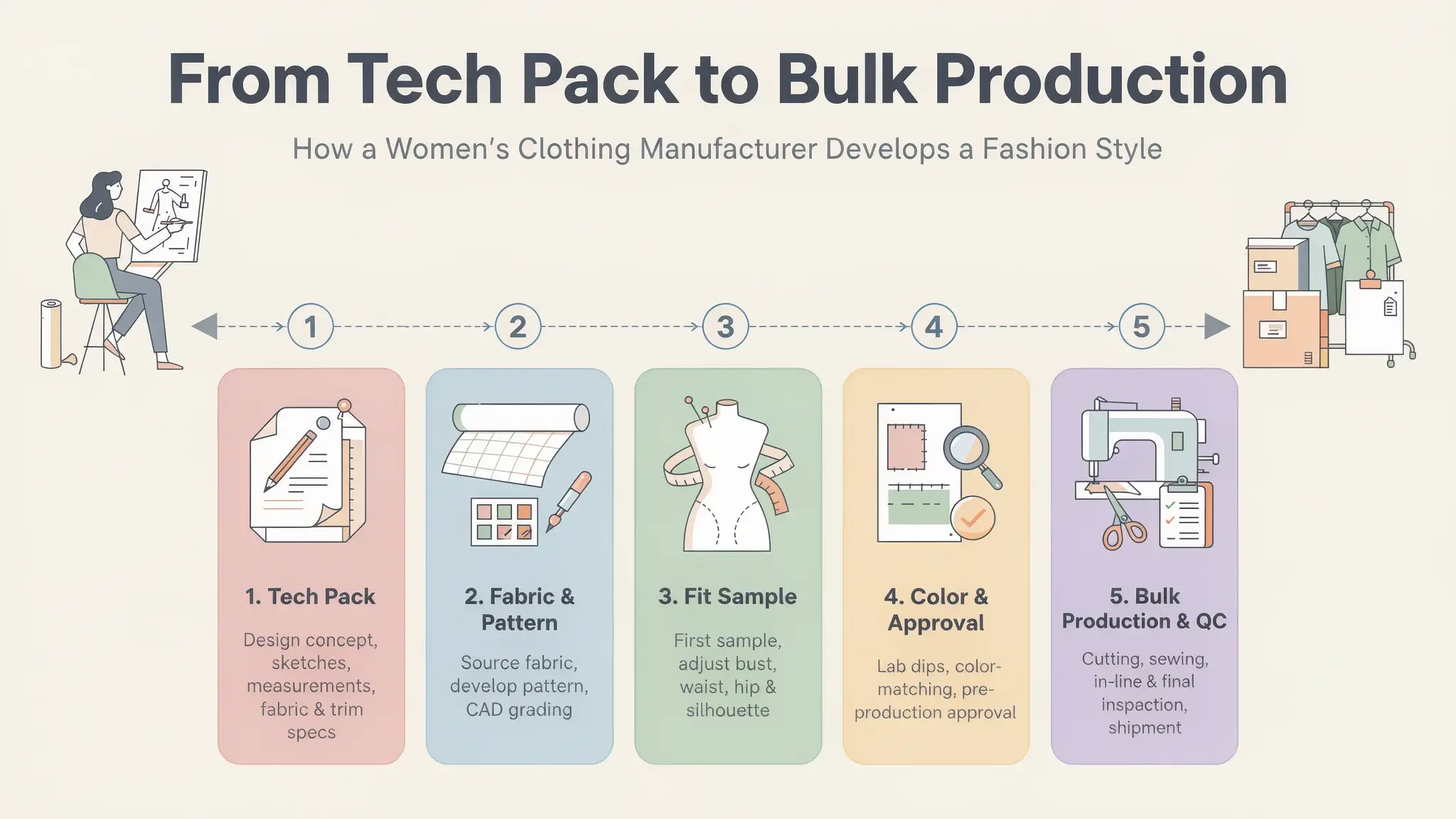
For a fashion brand, creating a new women's clothing style is much more than sending a design to a factory and waiting for production.
A successful garment goes through multiple stages before it becomes a finished product — from fabric sourcing and pattern development to fit samples, color approval, quality control, and bulk production.
For brands working with an overseas women's clothing manufacturer, understanding this process can help reduce development mistakes, avoid unnecessary delays, and achieve more consistent quality.
In this guide, we explain how a professional apparel manufacturer can take a women's fashion design from the initial concept to finished production.
1. Start with the Tech Pack or Design Concept
The development process usually starts with a tech pack, sketch, reference garment, or design concept.
A good tech pack may include:
-
Garment sketches
-
Measurements
-
Construction details
-
Fabric specifications
-
Color information
-
Trim details
-
Label requirements
-
Artwork and print placement
-
Stitching requirements
-
Packaging instructions
However, not every fashion brand has a complete tech pack when approaching a manufacturer.
An experienced women's apparel manufacturer should be able to work with different types of development information, including technical packages, reference samples, measurements, sketches, and design concepts.
The clearer the information at the beginning, the easier it is to develop an accurate first sample.
2. Select the Right Fabric
Fabric selection can have a major impact on the final appearance, fit, cost, and performance of a garment.
For women's fashion, the same design can look completely different depending on the fabric.
For example, a dress made from viscose may have a soft, flowing appearance, while the same pattern made from a structured woven fabric can create a completely different silhouette.
Common women's apparel fabrics include:
-
Cotton
-
Viscose
-
Linen
-
Polyester
-
Jersey
-
Fleece
-
PU and faux leather
-
Recycled fabrics
-
Blended fabrics
A professional manufacturer should consider more than fabric appearance.
Fabric weight, width, shrinkage, color, hand feel, construction, and performance should also be evaluated before bulk production.
At SENSENG, fabric and materials are inspected before cutting, while fabric sourcing and development are supported by dedicated sourcing teams.
The right fabric is not simply the fabric that looks good on a swatch. It is the fabric that works for the actual garment.
3. Develop the Pattern
Once the fabric and construction have been determined, the garment pattern can be developed.
Pattern development translates a two-dimensional design concept into the actual components required to manufacture a garment.
For women's apparel, this stage can be particularly important because small changes in pattern shape can significantly affect:
-
Bust fit
-
Shoulder position
-
Waist shape
-
Hip fit
-
Garment length
-
Sleeve shape
-
Overall silhouette
A professional pattern-making team should understand both the design intention and the practical requirements of mass production.
At SENSENG, the pattern-making team uses CAD software, while sample technicians with production experience are involved in the development process.
4. Make the First Fit Sample
The first sample is where the design begins to become a real garment.
The purpose of a fit sample is not simply to see whether the garment can be sewn.
It allows the brand and manufacturer to evaluate:
-
Overall silhouette
-
Garment measurements
-
Proportion
-
Fit
-
Construction
-
Fabric behavior
-
Sewing details
-
Trim placement
-
Design details
For fashion brands, this stage can require several rounds of adjustment.
A professional manufacturer should document fit comments and communicate clearly with the customer so that each revision moves closer to the approved design.
This is especially important for women's fashion because fit and silhouette are often central to the product's commercial appeal.
5. Check Fit and Make Corrections
A common mistake in garment development is trying to move into bulk production too quickly.
A sample that looks acceptable on a mannequin may not fit correctly on the intended fit model.
During fitting, the technical team may need to adjust:
-
Bust measurement
-
Waist measurement
-
Hip measurement
-
Shoulder width
-
Armhole
-
Sleeve length
-
Body length
-
Neckline
-
Ease
-
Overall proportions
Each correction should be recorded and incorporated into the next version of the pattern or sample.
The goal is to make sure that the approved sample represents the actual production standard.
6. Control Color and Appearance
Color is another critical part of women's apparel development.
A garment can have the correct design and construction but still fail to meet expectations if the color is inconsistent.
Depending on the product, development may involve:
-
Lab dips
-
Strike-offs
-
Handlooms
-
Print approval
-
Fabric color approval
-
Color matching
-
Bulk color control
Color should be evaluated under appropriate conditions and compared against the approved standard.
This becomes particularly important when a collection contains multiple garments that need to coordinate with each other.
Color consistency is not just a design issue. It is a production-control issue.
7. Review Construction and Production Risk
Before bulk production begins, the manufacturer should review the style for potential production risks.
This can include:
-
Difficult sewing operations
-
Unstable fabrics
-
Shrinkage
-
Seam construction
-
Trims and accessories
-
Print or embroidery
-
Washing processes
-
Special finishes
-
Sharp-object risks
-
Packaging requirements
A design may look simple but still contain production challenges.
For example, lightweight woven fabrics may require different handling from heavier woven fabrics, while garments with embroidery, washing, pleating, special trims, or faux leather materials may require additional production controls.
This is why risk assessment should take place before bulk production, not after a problem appears.
SENSENG states that its quality system includes sample and fit procedures, color and material control, testing and inspection, risk assessment, production and packing procedures, and sharp-object control.
8. Approve the Pre-Production Standard
Before bulk production starts, the manufacturer and buyer should agree on the production standard.
The approved standard may include:
-
Final fit sample
-
Approved fabric
-
Approved color
-
Approved trims
-
Approved artwork
-
Measurement specifications
-
Construction details
-
Label requirements
-
Packaging requirements
This approved sample becomes the reference for bulk production.
The purpose is simple:
The factory needs to know exactly what the buyer has approved before producing hundreds or thousands of garments.
9. Control Quality During Bulk Production
Bulk production is where development decisions are tested on a much larger scale.
A garment that works perfectly in a sample room may behave differently when produced in large quantities.
Quality control should therefore continue throughout production.
Depending on the garment, quality control can include:
-
Fabric inspection
-
Cutting accuracy
-
Sewing workmanship
-
Measurement checks
-
Color consistency
-
Print and embroidery inspection
-
Trim inspection
-
In-line inspection
-
Final inspection
SENSENG operates both woven and cut & sew production facilities and serves women's fashion categories including tops, dresses, skirts, pants, jackets and other woven and cut-and-sew garments.
10. Conduct Final Inspection Before Shipment
Before garments are packed and shipped, the finished products need to be checked against the approved requirements.
Final inspection may cover:
-
Measurements
-
Workmanship
-
Fabric defects
-
Color
-
Sewing
-
Trims
-
Labels
-
Prints and embroidery
-
Appearance
-
Packaging
-
Quantity
AQL-based inspection can also be applied according to the buyer's requirements. SENSENG's FAQ states that its standard is AQL 2.5 unless otherwise required.
The final inspection is the last major opportunity to identify problems before the goods leave the factory.
Why the Development Process Matters to Fashion Brands
Choosing a women's clothing manufacturer based only on unit price can be misleading.
A lower production price does not necessarily mean a lower total cost.
Poor development can result in:
-
Multiple sample revisions
-
Fabric waste
-
Incorrect fit
-
Production delays
-
Rework
-
Quality claims
-
Shipment delays
-
Customer returns
A manufacturer with a structured development process can help identify potential problems earlier.
This is particularly important for fashion brands operating on short product-development cycles.
Good manufacturing is not just about producing garments. It is about controlling the process that creates those garments.
What Should You Look for in a Women's Clothing Manufacturer?
When evaluating a potential manufacturing partner, ask these questions:
Does the factory have its own pattern and sample development capability?
Can the manufacturer work from a tech pack, reference sample, or design concept?
How does the factory source and inspect fabrics?
How many fit-sample revisions are normally required?
How is color approval managed?
Does the factory conduct risk assessment before production?
How is bulk production quality controlled?
What inspection standard is used?
Can the manufacturer handle both woven and cut & sew garments?
Can the factory support special processes such as printing, embroidery, washing, or embellishment?
These questions can tell you much more about a manufacturer's capabilities than simply asking for a quotation.
SENSENG: From Fashion Concept to Finished Garment
SENSENG works with fashion brands on women's apparel development and manufacturing, with capabilities covering sourcing and fabric development, pattern making, sample and fit, color control, risk assessment, inspection, and bulk production.
Our women's apparel product range includes:
-
Women's Tops
-
Dresses
-
Jumpsuits
-
Skirts
-
Pants
-
Jackets
-
Woven Fashion
-
Cut & Sew Apparel
The company operates woven and cut & sew production facilities and has experience producing lightweight woven fashion styles as well as heavier woven garments and cut-and-sew products.
From the first design concept to the final shipment, our objective is to provide brands with a controlled and efficient product-development and manufacturing process.
Have a women's apparel design that you want to develop?
Contact SENSENG to discuss your next collection.
Frequently Asked Questions
What does a women's clothing manufacturer do?
A women's clothing manufacturer can support multiple stages of apparel development and production, including fabric sourcing, pattern making, sampling, fit development, color approval, production, quality control, inspection, and packing.
Do I need a complete tech pack to start working with a clothing manufacturer?
Not necessarily. A complete tech pack can make development more efficient, but an experienced manufacturer may also be able to start from a reference garment, measurements, sketches, or other product information.
How long does it take to develop a women's clothing sample?
The timeline depends on the garment style and complexity. Basic styles may require less development time, while fashion styles, jackets, and garments with special construction can require additional development.
Can a manufacturer help me source fabric?
Yes. Fabric sourcing and development can be an important part of the manufacturer's service, particularly when the brand does not already have an approved fabric supplier.
Why is fit sampling important for women's clothing?
Fit sampling allows the brand and manufacturer to evaluate the garment's measurements, silhouette, proportions, construction, and overall appearance before committing to bulk production.
What is the difference between a women's clothing manufacturer and a garment trading company?
A manufacturer is directly involved in product development and production, while a trading company may primarily coordinate sourcing and production through third-party factories. For brands that require close control over fit, quality, development, and production, direct manufacturing capabilities can provide greater process control.